

Nicole Pratt | June 2026
Early in my career, I was known as the “survey lady.”
I couldn’t be in every room to ensure high-quality training for teachers across a whole state. So I learned to rely on surveys, and ultimately data, to understand what was happening. The data helped me see where things were going well and where teams might need more support. It helped me learn to listen and understand what was happening at scale, even if I couldn’t be there in person.
From School-Level Benchmarks to Sector-Level Questions
For nearly 10 years, EdFuel has conducted a national charter school compensation and benefits study in partnership with national and regional education support organizations. Over time, this study has helped charter schools understand how their salaries and benefits compare to peers and make decisions that reflect their values, talent strategies, and financial realities.
This year, we started looking beyond the individual school reports and getting curious about what we could learn about the charter sector as a whole. That question is at the center of our 2025 compensation and benefits trends work.
Looking at Total Rewards
This year, we are looking closely at what last year’s 2025 study tells us about the current state of total rewards in charter schools. We are examining salaries and benefits across roles, including teachers, principals, CEOs, operations teams, and non-instructional staff.
Compensation is one of the most important choices a school makes. It influences how schools attract and retain staff, how employees experience the organization, and whether the financial model remains sustainable over time. It is also one of the clearest ways an organization communicates what it values. A strong compensation approach helps schools align their talent priorities, values, and financial realities in a thoughtful and sustainable way.
At the same time, many school leaders are making compensation and benefits decisions without a full view of the broader landscape. They know their own pay practices and where they feel pressure, but may not have clear benchmarks for how their compensation compares with similar schools, whether their challenges are local or sector-wide, or how benefits shape the overall employee value proposition.
Leaders who have participated in EdFuel’s National Charter School Compensation and Benefits Study over the years have shared that their reports help fill those gaps and give a more complete picture of how they compete.
“Understanding how our compensation and benefits compare nationally and locally was most valuable, as it gave us clear context on our competitiveness. It also helped identify gaps and strengths across roles, allowing us to prioritize where adjustments are needed most to support equity, retention, and long-term sustainability.” Charter School Leader, Participant in EdFuel’s National Charter School Compensation and Benefits Study
What We’re Sharing
For years, the study has helped individual schools understand how they compare to peers. This year, we began asking a different question: What can this data teach us about the charter school sector itself? We started sharing these questions and early themes in our inaugural trends webinar, The Full Picture: Staffing, Compensation, & Benefits Across Charter Schools, in May. The conversation made clear that there is real interest across the field in moving beyond one-off comparisons and toward a deeper understanding of how charter schools are investing in people.
The webinar was an important starting point. In July, EdFuel will release two additional resources to support both individual schools and the broader education sector:
- An interactive benchmarking database that gives schools, support organizations, consultants, and other sector partners the ability to explore salary data directly
- A report on the 2025 trends regionally and nationally across salaries, benefits, and staffing
Preview Our Interactive Benchmark Database
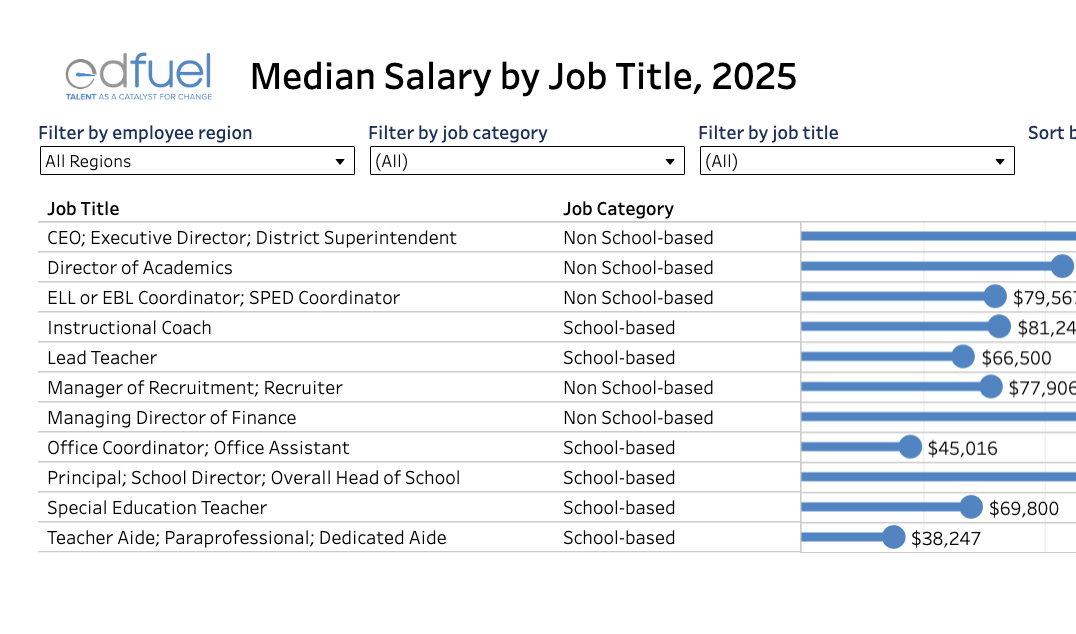
As a preview to our interactive benchmarking database access, we’re sharing a public dashboard that provides a subset of national salary benchmarks for common school-based and leadership roles. Premium access, coming in July, will unlock the full salary database, including all available roles (over 110 total), regional breakdowns, and detailed filters that help you compare against relevant charter school peer contexts, including operator size and cost of living.
Looking for more? Get premium access to all roles when the benchmarking database is released in July. Sign up here to get notified directly when it launches!

Preview Our Full Report
EdFuel’s 2025 National Charter School Compensation and Benefits Study, our largest to date, offers a sector-wide look at how charter schools and networks are approaching compensation, benefits, and staffing. The findings underscore a central lesson: the strongest talent strategies connect salary, benefits, staffing structure, and communication into a clear and compelling value proposition for staff. Here are a few key takeaways:
- Participating charter schools and networks report spending more than 63% of their operating budgets on personnel.
- Charter school teachers in the Midwest and Northeast, on average, have access to more benefits offerings than teachers in other parts of the country.
- Special education teachers at participating schools and networks typically earn more, on average, than general education teachers.
Not Just for Schools
This work is not just for schools. It is for policymakers, funders, authorizers and ultimately, anyone who believes we need to think more honestly and boldly about compensation and benefits in education.
I may no longer be the “survey lady,” but I still believe deeply in the power of data to help us see both the details and the broader picture. Be sure to keep an eye out next month for our full report and premium access to charter school benchmarks for over 110 educational roles!
If you’re interested in our 2027 National Charter School Compensation and Benefits Study, sign up to learn more.