





Performance Management Systems
Managers often struggle to provide consistent feedback, leaving staff unclear on where they stand. Performance reviews happen, but they don’t always lead to clear expectations or meaningful development. We design performance management systems that help organizations set clear expectations, evaluate performance consistently, and support staff growth over time, enabling leaders to deliver meaningful feedback and apply consistent evaluation practices across teams. The result is greater manager confidence, clearer performance standards, and systems that support both staff growth and accountability.









As organizations grow, performance practices often evolve in response to immediate needs rather than a cohesive system.
Evaluation, feedback, and management approaches can vary widely across teams, creating inconsistency in how performance is managed. Leaders may notice that performance conversations happen inconsistently, leaving managers unsure how to support staff growth or address challenges.
Over time, these gaps make it difficult to maintain clear expectations and consistent performance practices across the organization.
When Organizations Turn to Performance Management Systems
Common signs include:

Performance reviews feel rushed or procedural

Managers are unsure how to give effective feedback

Staff are unclear about performance expectations and where they stand

Difficult performance conversations are avoided

Development discussions happen inconsistently

The Challenges We Address
Effective performance management systems create clear structures for communicating expectations, setting priorities, sharing feedback, and supporting growth. Without well-defined performance management systems in place, managers often rely on individual styles rather than shared expectations.
This leads to uneven experiences across teams and uncertainty in how performance is evaluated and supported.
Our work focuses on designing performance management systems that provide practical structures to guide performance conversations and equip managers to lead effectively.
The challenges we solve:

Unclear or inconsistent performance expectations across roles

Variability in how managers evaluate and assess performance

Limited tools or structure to support staff growth and development

Infrequent or inconsistent feedback throughout the year

Performance reviews that feel procedural rather than meaningful

Misalignment in how leaders define and evaluate performance



What You Get
Our work provides a practical performance management system, supported by tools and frameworks that enable managers to lead consistent, meaningful performance conversations across the organization
-
Performance management frameworks, including cycles and milestones
-
Role-aligned expectations and competencies
-
Evaluation rubrics and rating guidelines
-
Manager feedback and coaching tools
-
Structured goal-setting for staff and managers
-
Calibration processes to support consistency across teams
-
Implementation plans and communication guidance for rollout









How We Approach This Work
Our approach helps leaders design performance management systems that create clear expectations, support meaningful feedback, and enable consistent practices across teams. While the steps below reflect our typical approach, we adapt and move between them as systems take shape and new insights emerge.

-
Diagnose
We review current evaluation practices, feedback structures, and areas of strength and inconsistency.
-
Design
We develop performance frameworks, role expectations, and evaluation tools that support clarity and consistency.
-
Align
We work with leadership to ensure priorities and manager practices align with the system through training, tools, and clear expectations.
-
Implement
We support rollout through manager guidance, communication tools, and practical resources to ensure consistent application
-
Sustain
We provide documentation, tools, and processes to maintain clear, consistent, and effective performance practices over time.



Support for the Teacher Incentive Allotment (TIA)
EdFuel is proud to be an official Texas Education Agency (TEA) Teacher Incentive Allotment (TIA) Technical Assistance Provider. We’ve partnered with school districts, such as Alief ISD, Deer Park ISD, and Pasadena ISD, to design impactful and sustainable local designation systems that meet TEA requirements, strengthen teacher retention, and generate large district allotments annually.
We support districts with:
- Designing local designation systems aligned with TIA requirements
- Preparing and strengthening TIA applications
- Conducting robust stakeholder engagement to gather buy-in and investment
- Implementing fair and consistent observation practices
- Selecting student growth measures
- Creating sustainable compensation and recognition structures
- Supporting implementation and long-term system sustainability


What This Looks Like in Practice
Alief ISD partnered with EdFuel to design a rigorous performance evaluation system aligned with Texas's Teacher Incentive Allotment program. EdFuel worked with district leadership to assess their existing system, developed evaluation rubrics and processes, and piloted the model before full implementation.
Now in the second consecutive year of partnership, Alief ISD again achieved strong TIA outcomes, successfully completing another year of data validation.
As a result:

More than 500 teachers earned new or higher designations
An estimated $8 million in TIA allotments generated for the district
Consistent evaluation practices were established across 40+ schools
Increased teacher retention rates
The result was a performance management system that aligned instructional practice with student growth and gave leaders a clear, sustainable framework for evaluating and supporting teachers. This milestone reflects Alief ISD's sustained commitment to building strong, equitable talent systems — and enabled the district to offer meaningful additional compensation to top-performing teachers while securing significant state funding to support broader district initiatives.

FAQs
What are performance management systems?

Performance management systems are structured approaches that help organizations set clear expectations, evaluate performance consistently, and support employee growth and accountability over time.
How long does performance management system design typically take?
Most engagements range from six to twelve months, depending on the size of the organization and the complexity of the system.
Will this replace our current evaluation tools?
Not always. In some cases, we refine and strengthen existing systems. In others, we design new frameworks that better support organizational needs.
Do you support manager training as part of this work?
Yes. Many engagements include manager guidance and training to support fair and consistent implementation.
Can performance management align with other talent systems?
Yes. Many partners pair this work with compensation or workforce planning to ensure talent systems are aligned and reinforce one another.
Is This Right for You?
This service may be a strong fit if these challenges feel familiar. It is one component of our broader talent systems work.
-
You’re experiencing inconsistent performance expectations and feedback across teams.
-
You need a clear framework for evaluating and developing staff.
-
You want a performance system that supports both growth and accountability.

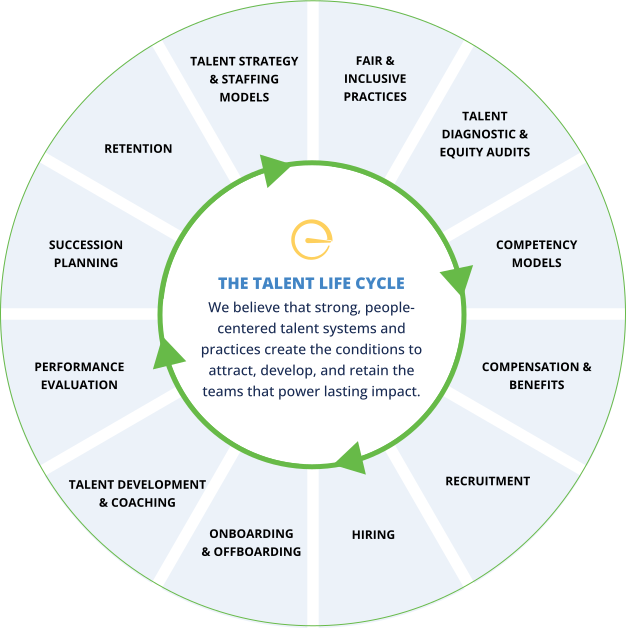
Performance management often connects to other elements of a strong talent system. Many partners engage with EdFuel on related work, such as leadership development, compensation strategy, workforce planning, and retention initiatives, to ensure that performance systems reinforce broader organizational goals.




From Talent Talks Blog
Explore practical insights on strategic workforce planning, compensation design, performance management,
and leadership development across education, mission-driven, and nonprofit organizations
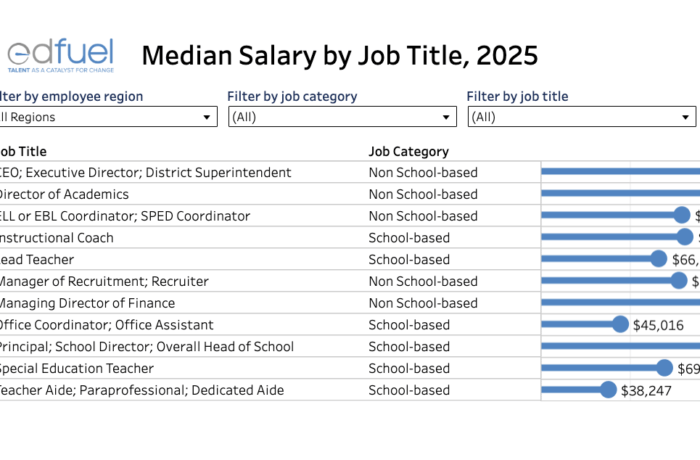
Compensation Is How Schools Show What They Value. Are We Paying Attention?
Nicole Pratt | June 2026 Early in my career, I was known as the “survey lady.” I couldn’t be in every room to ensure high-quality training for teachers across a whole state. So I learned to rely on surveys, and ultimately data, to understand what was happening. The data helped me see where things […]
Strategic Staffing in a Season of Disruption: What It Really Takes to Build Stability
Kerri-Ann Pitts | April 2026 Dear EdFuel Community, A year ago, I wrote what became one of the most vulnerable reflections of my career — leading through a reduction in force and what it required of me as a people-centered leader. I wasn’t sure how it would land. But the response told me something important: […]
Leading in the Tension: What It Takes to Support Teams Amid Uncertainty
Nicole Pratt | February 2026 Every year, the first sign of spring for me isn’t the green grass or leaves on the trees, it’s the daffodil leaves. Thin green shoots pushing up when the air still feels cold and the ground looks unchanged. They’re easy to miss, but once I notice them, I know something […]
