



Ashleigh Phillis, Director | April 2022
For most of us, the start of spring signals the return of warmer weather and blossoming flowers. For some, spring simply means that baseball is back.
I should note that I am not a baseball fan. Unfortunately, my husband is an avid Cleveland fan. And Cleveland baseball has had an anxious off-season. This is their first year as the newly renamed Cleveland Guardians and in the final days before opening day, fans faced rumors that one of their star players was about to be traded.
As I listened to my husband worry about the status of Cleveland’s third baseman, I heard echoes of conversations I have had with school leaders.
For school leaders, spring is recruitment season. And much like Cleveland fans concerned about José Ramírez’s contract, school leaders must navigate uncertainty. Who will be returning for the next school year? How will they replace outgoing staff? How can they prepare for unexpected and late attrition?
Comparing professional sports and education is both easy and frustrating. Fans feared Cleveland might trade Ramírez to the San Diego Padres on the eve of the first game, but instead the Guardians offered him a multi-year, multi-million dollar contract. None of the school leaders I have worked with could do the same for their top talent.
What stood out to me though was that Ramírez wanted to stay with the Guardians. His franchise record breaking contract is considered to be a great deal for the team because he could have earned more elsewhere. But Ramírez made it clear that he was committed to the team. School leaders can also build commitment among their staff and can begin doing so as soon as a new hire accepts an offer with a strong onboarding process. A well-planned onboarding process sets-up staff for success in a new role and makes it more likely they will commit to an organization longer.
Why Onboarding Matters
When teams sign someone like Ramírez, they and their fans celebrate with official announcements and social media posts. This happens not just with star players but also with newly drafted or traded players. Welcoming new teammates and building their confidence in the organization is the first part of a team’s onboarding process.
And it makes a difference. Onboarding, which is the process of helping new hires adjust to a company, its culture, and their role, ensures that a new hire feels ready for their first day and can reduce attrition over time. 69% of employees say they are more likely to stay with an organization for three years if their onboarding experience was great.1
In education, a field where 44% of new teachers leave the profession within five years2, a strong onboarding process can make a huge impact. Teachers who have a positive and supportive onboarding process are twice as likely to stay in the classroom as those who do not.3 Yet, onboarding is not consistently offered across school districts. Almost 20% of school districts lack a formal induction program for novice teachers.4
Given the ongoing concerns about a teacher shortage, exacerbated by the pandemic5, what can school leaders do to create a strong onboarding experience for their new hires?
Onboarding Goes Beyond Beyond Orientation
The trade rumors around Ramírez continued and intensified, even after he started spring training with the Guardians. It wasn’t until the contract extension was signed that fans felt any relief.
From my experience working with school leaders, I know this is a feeling they can relate to. Will all of the teachers who show up at orientation and summer professional development still be here on the first day of school?
Building onboarding plans that start early and go beyond those first few weeks can help ensure schools are staffed on the first day of classes and after. Onboarding can be seen as having three phases:6
- Cultivation which begins after a new hire accepts their job offer and keeps them ‘warm’ and engaged before their first day
- Orientation which takes place during a new hire’s first few days and weeks and gives them the information, context, and expectations they need before the year begins
- Management which occurs over the first several months or even the first year of school and provides new hires with intentional, ongoing support to navigate their ups and downs at a new school
Often onboarding and orientation are conflated and new hires no longer receive support after their first few weeks. Orientation is only supposed to be a one-time event and summer professional development typically focuses on preparing new and returning teachers for the upcoming school year.
A good onboarding plan should include a management phase that extends past those first few weeks and should be seen as a journey that allows employees to experience and learn what is needed for their role.7 This is especially important because teachers hired after the start of the school year, who miss orientation and have less preparation time, can be less effective and are more likely to leave.8
Longer onboarding can look different for individual schools and staff, but setting clear goals for the overall process is important to developing a strong process.9 School leaders should take time to create onboarding plans for their specific schools.10 These plans can include:
- Intensive induction programs that allow teachers time to gradually develop their skills, to receive coaching from accomplished teachers, and to understand their school’s professional expectations.11 Induction programs can increase retention and increase teacher effectiveness.12
- Novice teacher mentoring programs or buddy programs, which can have a positive impact on new teacher retention. In one study, 97% of new teachers who had at least 10 hours of mentoring a month were retained compared to the 78% of teachers who received fewer than four hours of mentoring.13
- Tailored processes for experienced teachers who might not need the same type of support as novice teachers, but still need to understand a new school’s culture, rules, and guidelines. These can also include ‘reboarding’ plans for current employees who are returning to the classroom or who have been transferred or promoted.14
Developing an onboarding process with strong orientation and management phases takes time and should be individualized for each school, but a thoughtful process should start with the cultivation phase as soon as a new hire accepts their offer.
Onboarding Starts Early
Looking at how baseball teams celebrate their new team members isn’t the worst example. Welcoming new employees is an important part of onboarding and should begin before a new hire’s first day.
As a school recruiter, spring was my busiest season and when many of my school leaders started hiring teachers. Practically, this led to teachers accepting an offer in April (or earlier) and waiting five months before starting in August. Many newly hired teachers do not hear anything from their school during this time.
The lack of communication between newly hired teachers and school leaders can lead to uncertainty on both ends. By creating an onboarding process that includes an intentional cultivation phase that includes ongoing communication and touchpoints through the spring and summer, school leaders show their commitment to their new hires. This in turn helps new hires feel welcomed and invested in their school and their responsiveness and engagement informs school leaders about their commitment.15
There are many ways that school leaders can both welcome and continue to cultivate new hires during this time.16
- Send individual welcome emails from school leaders, grade team leaders, and/or department heads shortly after new hires accept their offer
- Invite new hires to end-of-year school events such as graduation or awards ceremonies
- Schedule calls between new hires and current staff during the spring and summer
- Add new hires to school newsletter listservs so they can stay up-to-date about what is happening at the school
- Host in-person or remote events for new hires such as Zoom tours, coffee dates, or opportunities to shadow current teachers during the school year
- Share information about required HR documents, paperwork, and certification expectations
- Provide logistical information about the layout of the school and schedules for orientation, summer professional development, and the first week of school before their first day
Starting with a strong cultivation phase can help school leaders feel confident about who will show up on the first day and continuing with well-planned orientation and management phases can increase the likelihood of retaining teachers. Reducing teacher turnover and increasing stability within a school not only positively impacts teachers, but also student achievement and school culture.17
For the Cleveland Guardians, signing Ramírez to a long-term contract has done the same. His commitment to the team, along with his much needed offensive power, gives fans a sense of stability and hope that Cleveland can make the playoffs. Staying with Cleveland seems to have motivated Ramírez as well, he has started the year as one of the best hitters in baseball.
We want to hear from you: How does your school engage new hires? How does your school use onboarding to build commitment among its staff?
1Hirsch, A. (2017, August 10). Don’t Underestimate the Importance of Good Onboarding. SHRM. https://www.shrm.org/resourcesandtools/hr-topics/talent-acquisition/pages/dont-underestimate-the-importance-of-effective-onboarding.aspx
2Ingersoll, R., Merrill, E., Stuckey, D., & Collins, G. (2018). Seven Trends: The Transformation of the Teaching Force – Updated October 2018. CPRE Research Reports. Retrieved from https://repository.upenn.edu/cpre_researchreports/108
3Podolsky, A., Kini, T., Bishop, J., & Darling-Hammond, L. (2016). Solving the Teacher Shortage: How to Attract and Retain Excellent Educators. Learning Policy Institute. Retrieved from https://learningpolicyinstitute.org/product/solving-teacher-shortage
4Konoske-Graf, A., Partelow, L., & Benner, M. (2016). To Attract Great Teachers, School Districts Must Improve Their Human Capital Systems. Center for American Progress. https://www.americanprogress.org/article/to-attract-great-teachers-school-districts-must-improve-their-human-capital-systems/
5 El-Bawab, N. (2022, April 3). How to reverse the teacher crisis exacerbated by the pandemic: Experts. ABC News. https://abcnews.go.com/US/reverse-teacher-crisis-exacerbated-pandemic-experts/story?id=83792346
6TNTP. (n.d) Onboarding New Teachers: What They Need to Succeed. https://tntp.org/assets/tools/TNTP_NewTeacherOnboarding.Toolbox2012_TSLT%203.12.pptx
7Wigert, B. & Pendell, R. (2019, March 1). 7 Problems With Your Onboarding Problem. Gallup. https://www.gallup.com/workplace/247172/problems-onboarding-program.aspx
8Podolsky. Solving the Teacher Shortage
9TMaurer, R. (n.d.). New Employee Onboarding Guide. SHRM. https://www.shrm.org/resourcesandtools/hr-topics/talent-acquisition/pages/new-employee-onboarding-guide.aspx
10TNTP. (n.d.) New Teacher Onboarding and Cultivation. https://tntp.org/assets/covid-19-toolkit-resources/Virtual_Onboarding_and_Cultivation_Guide_TNTP.pdf
11Konoske-Graf. To Attract Great Teachers.
12Podolsky. Solving the Teacher Shortage
13Caven, M., Durodoye, R., Jr., Zhang, X., & Bock, G. (2021). Variation in Mentoring Practices and Retention across New Teacher Demographic Characteristics under a Large Urban District’s New Teacher Mentoring Program.U.S. Department of Education, Institute of Education Sciences, National Center for Education Evaluation and Regional Assistance, Regional Educational Laboratory Northeast & Islands. http://ies.ed.gov/ncee/edlabs.
14SHRM. (n.d.) Understanding Employee Onboarding. https://www.shrm.org/resourcesandtools/tools-and-samples/toolkits/pages/understanding-employee-onboarding.aspx
15TNTP. (n.d.) Strategies to Cultivate New Hires. https://tntp.org/assets/teacher-talent-toolbox-resources/Strategy_-_Cultivating_New_Hires.pdf
16TNTP. Strategies to Cultivate New Hires.; Rockwood, K. (2020, May 22). How to Create an Effective Onboarding Program. SHRM. https://www.shrm.org/hr-today/news/hr-magazine/summer2020/pages/creating-an-effective-onboarding-program.aspx; TNTP. New Teacher Onboarding and Cultivation.
17Podolsky. Solving the Teacher Shortage
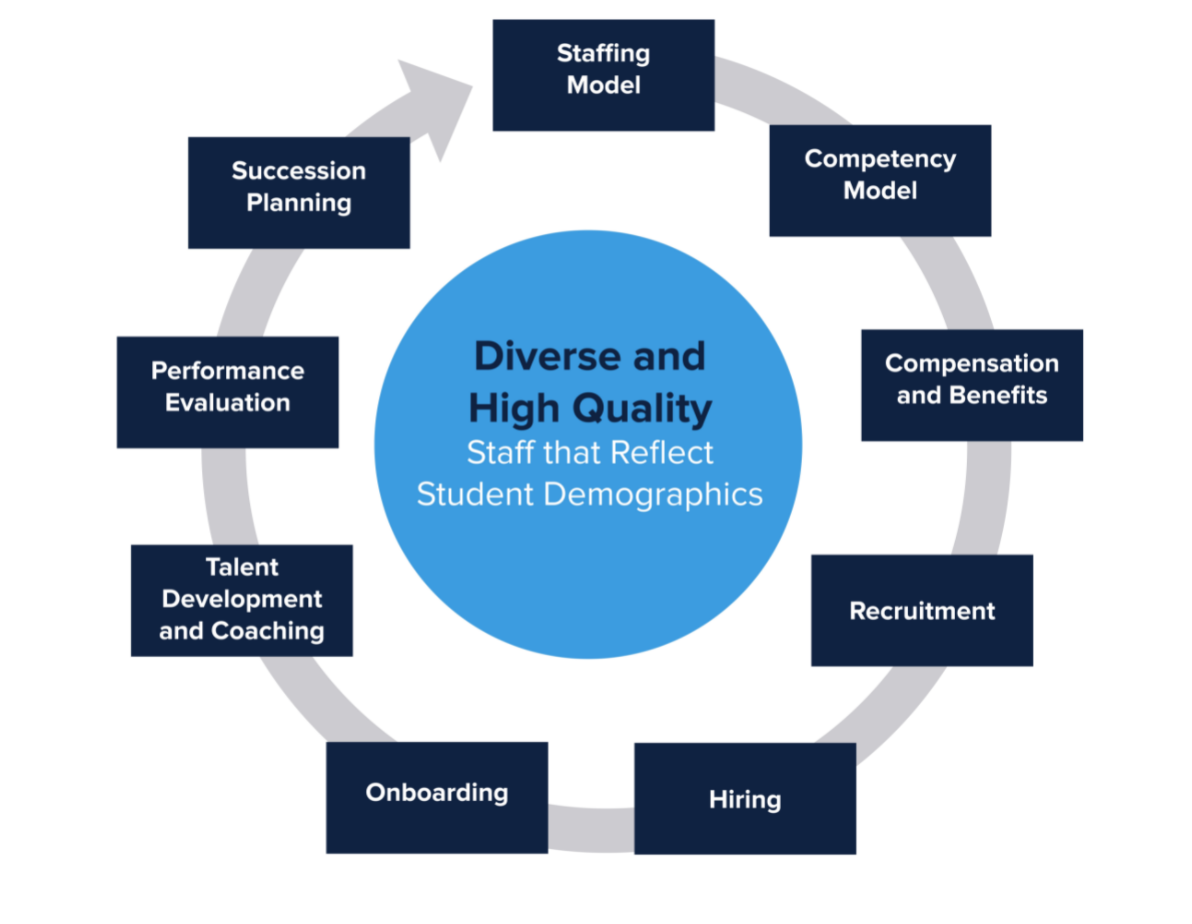 After engaging in this prioritization and ranking exercise, we selected the following external and internal priorities: